

What a lease really costs: upfront money and effective monthly
The two numbers an ad never shows you: what leaves your account at signing, and what the lease costs per month once that money is spread across the term.
By LeaseGuru.aiUpdated 11 min read
Lease ads compete on one number: the monthly payment. That number is the easiest part of the deal to move, because anything the advertiser shifts into the amount due at signing disappears from it. Two offers on the same car, same term, and same mileage can differ by a large monthly figure purely because one collected more cash upfront.
So the honest question is not "what is the payment?" It is "what is the total I hand over across this lease, and what does that work out to per month?" That second figure—effective monthly cost—is the only one that lets you rank offers with different signing amounts against each other.
This guide covers what upfront lease costs actually consist of, why a low payment is not automatically a good deal, the costs that show up after you sign, and how the leasing-versus-financing trade-off looks once you price both the same way.
TLDR Quick Guide
The short version:
- Upfront cost (drive-off, due at signing) is first payment + acquisition fee + taxes + registration/doc fees + any cap cost reduction.
- A low monthly payment usually means a big cap cost reduction. That is your money moved earlier, not saved.
- Effective monthly = (monthly payment × term + total drive-off) ÷ term. Compare offers on that, not on payment.
- Cap cost reduction is not refundable. If the car is totaled early, gap covers the lender, not the cash you put down.
- Some costs land after signing: mileage overage, disposition fee, wear-and-tear chargebacks.
- Leasing and financing answer different questions—compare them over your real hold period, not over 36 months.
What lease upfront costs actually consist of
"Due at signing," "drive-off," and "cash due" all describe the same thing: the money that leaves your account before you get the keys. It is not one fee, it is a stack of them, and the stack is where advertisers hide the difference between two offers that look identical.
| Line item | What it is | Negotiable? |
|---|---|---|
| First month's payment | The first of your monthly payments, collected upfront rather than billed | No—but it is not an extra cost, just timing |
| Acquisition fee | The captive lender's charge to originate the lease | Set by the lender; sometimes rolled into cap cost instead of paid in cash |
| Capitalized cost reduction | Cash down. Lowers the amount financed, which lowers the payment | Entirely your choice—this is the line that shrinks advertised payments |
| Taxes | Varies by state: some tax the monthly payment, some tax upfront | No, but the method changes how much is due at signing |
| Registration, title, dealer doc fee | State and dealer paperwork charges | Doc fee is capped in some states; the rest are pass-through |
| Optional products | Prepaid maintenance, extra wear coverage, prepaid mileage | Yes—decline anything you did not ask for |
Drive-off decoder: itemize a signing sheet: Enter each line from a quote and see what totals as due at signing—and which lines are negotiable.
The acquisition fee is real money and varies by brand
Acquisition fees are set by the captive lender, not the dealer, and the spread between brands is wide. From published lease disclosures: BMW Financial Services names $925, Audi Financial Services $895, Toyota Financial Services $750, and Southeast Toyota Finance (the regional Toyota arm covering AL, FL, GA, NC, SC) $695. Same shopper, same budget, several hundred dollars of difference before anyone talks about the car.
"Zero down" does not mean zero upfront
Zero-down almost always means zero capitalized cost reduction. First payment, acquisition fee, taxes, and registration are usually still due in cash. Read the fine print for the words "excludes tax, title, license, and acquisition fee"—that phrase is doing a lot of work.
Why a low monthly lease payment is not always a good deal
A monthly payment is an output, not a price. Four inputs produce it: the negotiated selling price, the residual value, the money factor, and how much cash you put down. Only one of those is easy to change on the spot, and it is the last one. Push enough into cap cost reduction and almost any car produces an attractive-looking payment.
That is why the payment alone cannot rank two offers. The offer with the lower payment may simply be the one that asked for more of your money earlier. Effective monthly cost fixes this by putting the drive-off back where it belongs.
- Effective monthly cost = (monthly payment × number of months + total due at signing) ÷ number of months
- Run both offers with the same term and the same mileage allowance, or the comparison is meaningless
- Refundable items—security deposits you get back—can be left out; a cap cost reduction cannot, because it is gone
- If the two offers have different terms, compare total cash outlay over the shorter one and note what happens after
Effective monthly cost calculator: Spread drive-off across the term so a low-payment/high-down offer and a high-payment/low-down offer land in the same units.
Cash down is risk, not savings
A capitalized cost reduction buys down the amount financed, so it does reduce total finance charge slightly. But it is not a deposit and you do not get it back. If the car is stolen or totaled in month four, the insurance settlement and gap waiver pay the lender's remaining balance—they do not refund the cash you prepaid. On a lease you never own, large cash down concentrates risk for a modest return.
Where else the payment gets flattered
- A lower mileage tier: 7,500 miles a year prices better than 12,000, and costs you at return if you drive normally
- A longer term: 39 or 42 months spreads depreciation thinner but keeps you paying longer
- A marked-up money factor hidden behind a big incentive, so the payment still looks competitive
- Multiple security deposits quoted as if the deposit money were free—it is refundable, but it is tied up
- Top-tier credit assumptions in the ad that your actual approval will not match
The costs that arrive after you sign
Upfront and monthly are only two thirds of the picture. A lease has a bill at the end too, and it is the part shoppers price at zero. Budget for it while you are still choosing, because by the time it arrives your only lever is which car you return.
- Mileage overage, charged per mile above your allowance. Published captive rates run from $0.15/mile at Toyota Financial Services and $0.20/mile at Honda Financial Services up to $0.30/mile at BMW Financial Services.
- Disposition fee when you hand the car back: Toyota Financial Services and Lexus Financial Services publish up to $350, GM Financial up to $495. Most captives waive it if you lease or buy from the same brand again.
- Excess wear and tear beyond the contract's guidelines—tires, glass, panel damage.
- Any remaining payments if you exit the lease early.
Mileage overage rates by brand
Price the mileage tier honestly
Buying miles upfront is nearly always cheaper than buying them at return—captives publish a prepaid rate below the return rate for exactly this reason. But the cheapest option is picking the right tier from the start. Estimate your real annual mileage from the last two years of driving, not from what makes the payment look good.
Leasing vs financing: the pros and cons on cost
Once you can price a lease properly, the leasing-versus-financing question stops being a slogan and becomes arithmetic. The two are not competing versions of the same product: a lease buys a fixed period of use, a loan buys the car. They only look comparable because both produce a monthly payment.
| Leasing | Financing | |
|---|---|---|
| Monthly payment | Lower for the same car and term—you pay depreciation, not the full price | Higher, because you are paying down the whole vehicle |
| Upfront cost | First payment, acquisition fee, taxes, fees; cash down optional | Down payment, taxes, fees; the down payment builds equity |
| End of term | Return the car, possibly owing disposition, mileage, and wear charges | You own an asset with resale value and no payment |
| Mileage | Capped; overage billed per mile at return | Unlimited, though high mileage lowers resale |
| Wins when | You keep cars a few years, drive predictable miles, want a newer vehicle on a schedule | You keep cars long past the payoff, drive high miles, or want no restrictions |
The trap in both directions is comparing a lease payment to a loan payment. Compare instead over the period you actually keep cars: total cash out for the lease across its term, versus total cash out for the loan minus the vehicle's value when you would have sold it. Over a 3-year window the lease often wins; stretch it to 8 years and financing usually does.
Lease vs. buy: the full decision framework: The complete comparison—mileage, hold period, ownership goals, and how to run the numbers on both.
Putting it together before you sign
- Ask for the itemized due-at-signing block, not just "$X down"—you want every line named
- Ask for selling price, residual, money factor, term, and mileage allowance in writing
- Convert every offer to effective monthly cost before you rank them
- Confirm which fees are rolled into cap cost versus paid in cash, since that changes the payment but not the total
- Add your expected end-of-term costs—overage, disposition—to the total before you decide
- Check the signing sheet matches the quote; the contract governs, not the ad
Ready to price real offers?
Every listing here shows monthly payment, due at signing, and term in the same columns—so you can run the effective monthly math on live cars instead of an example.
- View deal details
 DemoScore100
2021 Porsche Taycan CPO Turbo S
- Monthly:
- $1,079/mo
- Due at signing:
- $5,499
- Term:
- 24 mo
California
- View deal details
 DemoScore96
2025 Audi A5 Premium
- Monthly:
- $239/mo
- Due at signing:
- $3,999
- Term:
- 24 mo
California
- View deal details
 DemoScore94
2026 Mercedes-Benz GLE SUV 4Matic 350
- Monthly:
- $379/mo
- Due at signing:
- $3,499
- Term:
- 24 mo
South
Key Takeaways
- Upfront lease cost is a stack: first payment, acquisition fee, taxes, registration and doc fees, plus any cash down. "Zero down" removes only the last one.
- A low monthly payment usually means a large cap cost reduction—your money moved earlier, not saved.
- Effective monthly cost = (payment × term + drive-off) ÷ term. It is the only way to rank offers with different signing amounts.
- Cash down on a lease is not refundable and is not protected by gap if the car is totaled.
- Budget for end-of-term costs too: mileage overage and disposition fees are published per brand and are easy to check before you commit.
- Leasing versus financing turns on how long you keep the car, not on which monthly payment is lower.
Ready to see real lease offers?
Share your ZIP and we'll match you with current deals. Free, no obligation.
FAQs
Typically the first month's payment, the lender's acquisition fee, sales tax as your state applies it, registration and title, the dealer doc fee, and any capitalized cost reduction you choose to pay. Only the cap cost reduction is optional; the rest are due in cash unless the lender lets you roll them into the capitalized cost.
Because the payment is an output of four inputs—selling price, residual, money factor, and cash down—and cash down is the easiest to change. Moving a few thousand dollars into due-at-signing drops the payment without lowering what the lease costs you. Spread the drive-off back across the term as effective monthly cost and the two offers often converge, or reverse.
Multiply the monthly payment by the number of months, add everything due at signing, then divide by the number of months. Leave refundable security deposits out. Compare only offers with the same term and mileage allowance—otherwise you are comparing different products.
Usually not much. A capitalized cost reduction lowers your payment and slightly lowers total finance charge, but it is not refundable and it is not returned to you if the car is totaled or stolen early—gap covers the lender's balance, not your prepaid cash. Most shoppers are better off keeping the cash and accepting the higher payment.
Over a short hold period, leasing usually costs less per month and less in total, because you pay depreciation rather than the whole vehicle. Over a long one, financing wins: the loan ends and you own an asset with resale value. Compare total cash out over the years you actually keep a car, not payment against payment.
Some of them. Selling price and any optional products are negotiable, the dealer doc fee is capped by law in some states, and cash down is entirely your choice. The acquisition fee is set by the captive lender and registration and tax are pass-through—those you can move into cap cost but not remove.
Related guides
 5 min
5 minWhat's due at signing on a car lease? Reading payments and drive-off
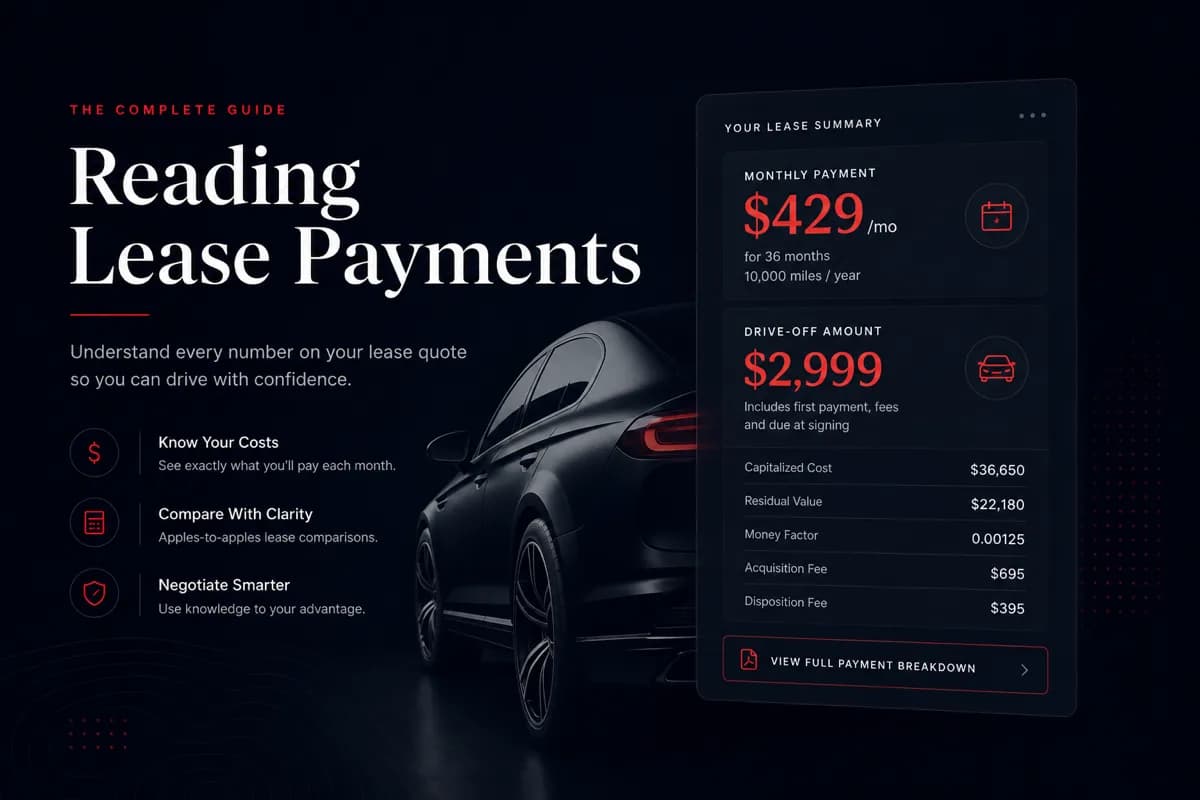
How to interpret payment, drive-off, term, and mileage when comparing lease listings online or from multiple brokers.
 5 min
5 minWhat car can you lease for $300 a month?
Which cars lease for $300 a month or less right now, what those deals actually cost once due-at-signing is included, and how to find a real $300 lease.
 4 min
4 minZero-down lease deals: what $0 down really means
Why “$0 down” and “no money down” lease deals still cost money at signing, and how to read drive-off when comparing zero-down specials.
Ready to compare?
Compare live listings by payment, drive-off, and term, then request help on a deal when you are ready.