
Disposition fees by brand
What each captive lender publishes as its lease-end disposition fee, why the number is a ceiling rather than a certainty, and the one move that removes it.
By LeaseGuru.aiUpdated 9 min read
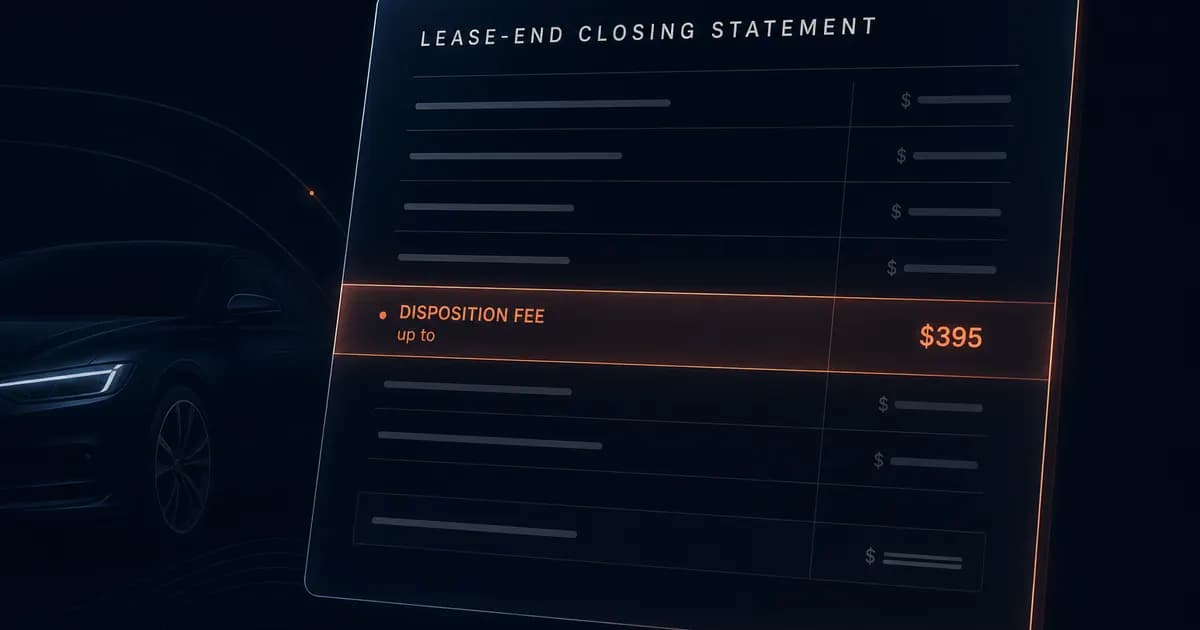
A disposition fee is what your lender charges to take the car back — inspect it, transport it, and put it through auction. It is the one lease-end charge that lands on essentially every return, regardless of how carefully you drove.
It is also the charge people most often get wrong before it arrives, because the published figures range from $300 to $495 and almost every source states them as a flat number. The lenders themselves do not. They say "up to," and they say "if allowed by your state."
Every figure below was read off a manufacturer or captive lender's own site. Where a captive does not publish its number, this guide says so rather than guessing — that gap is real, and a made-up number in its place is worth less than nothing.
TLDR Quick Guide
Read the fee as a ceiling, not a price:
- Published fees run $300–$495 across the captives that disclose them.
- Almost every source says "up to" — the contract you signed sets the actual number.
- State law can cap or eliminate it. Subaru excludes NY and WI outright; GM includes it only where the state allows.
- Every captive here waives it if you take another car from the same brand through the same lender.
- You do not pay it at all if you buy the car out at lease end.
- It stacks on top of excess mileage and excess wear — it does not replace them.
What each captive publishes
These are the amounts each lender states on its own lease-end pages, as of August 2026. The source column is there so you can re-check any row yourself rather than take this page's word for it.
| Brands | Captive lender | Published fee | Published on |
|---|---|---|---|
| Toyota, Lexus | Toyota Financial Services / Lexus Financial Services | Up to $350 | toyotafinancial.com |
| Chevrolet, GMC, Buick, Cadillac | GM Financial | Up to $495 | gmfinancial.com |
| BMW | BMW Financial Services | Up to $495 | bmwusa.com |
| Ford, Lincoln | Ford Motor Credit | $475 | ford.com |
| Nissan | Nissan Motor Acceptance (NMAC) | Up to $395 | nissanusa.com |
| Subaru | Subaru Motors Finance (Chase) | $300 | subarumotorsfinance.chase.com |
One naming quirk worth knowing: Ford Credit calls it a "disposal fee," not a disposition fee. If you search Ford's site for the usual term you will find nothing, and it is easy to conclude Ford does not charge one. It does.
"Up to" is doing real work in that table
Toyota, GM, BMW, and Nissan all phrase the fee as a maximum. That wording is not legal hedging for its own sake — it exists because the enforceable amount is whatever your signed lease says, and that figure varies by program year, by state, and occasionally by the dealer paperwork you signed on.
- The number in your contract is the number you owe. This table tells you what to expect, not what to argue with.
- A fee lower than the published cap is normal, not an error in your favor that someone will later correct.
- Find it under the lease-end or 'end of term' clause, usually near the excess wear and excess mileage language.
Your state may cancel it
Three of the six lenders flag state law directly in their own material, which is a strong signal that this varies more than the industry lets on. Their exact carve-outs:
- Toyota Financial Services / Lexus Financial Services: TFS warns that customers who originated in New Jersey may be billed for the fee before the waiver is applied.
- GM Financial: GM Financial states the fee is included in its leases only where the state allows it.
- BMW Financial Services: BMW caps the fee at the amount permissible by law in your state.
- Subaru Motors Finance (Chase): Subaru's own lease-end page excludes New York and Wisconsin from the fee.
If you leased in New York or Wisconsin, check before you budget for this at all. And note the Toyota case specifically — a New Jersey lessee can receive a bill for a fee that is later waived, which is alarming to open and not worth panicking over.
How to get it waived
This is the part worth acting on. Every captive in the table waives the disposition fee if you stay with the brand — the conditions differ in the details, and the details are where people lose the waiver.
| Captive lender | How the fee gets waived |
|---|---|
| Toyota Financial Services / Lexus Financial Services | Replace with a new or certified Toyota or Lexus financed or leased through a participating dealer and TFS or LFS within 30 days before or after return — or if you have had three or more TFS/LFS accounts. |
| GM Financial | Buy or lease a new GM vehicle. |
| BMW Financial Services | Lease your next BMW through BMW Financial Services, or finance the buyout of your current car through them. |
| Ford Motor Credit | Renew into a new Ford or Lincoln and finance it with Ford Credit. The waiver does not cover excess mileage, and does not stack with wear-and-use waiver products. |
| Nissan Motor Acceptance (NMAC) | Finance or lease a new, unused, unregistered Nissan through NMAC within 30 days of returning your current one. NMAC also waives up to $500 of excess wear under the same loyalty offer. |
| Subaru Motors Finance (Chase) | Subaru pays the fee under its Lease Loyalty Program when you lease a new Subaru through Subaru Motors Finance. |
- The timing window is real. Nissan and Toyota both specify 30 days; miss it and the waiver is gone even though you bought the same brand.
- It usually has to be financed through the same captive. Paying cash, or financing through your own bank, generally forfeits the waiver.
- Buying out your current lease removes the fee entirely — there is nothing to dispose of.
- Toyota's three-or-more-accounts route is unusual and easy to miss if you have leased with TFS or LFS before.
Brands that do not publish a number
Several major captives keep the amount behind a login or inside the contract only. Honda is the most-searched of these, and it is also where secondary sources are least reliable — some pages claim Honda Financial Services charges no disposition fee, which is not something Honda states anywhere public.
| Brands | Captive lender | Published fee | Published on |
|---|---|---|---|
| Honda, Acura | Honda Financial Services | Not published online | — |
| Hyundai, Kia, Genesis | Hyundai Capital America | Not published online | — |
| Mercedes-Benz | Mercedes-Benz Financial Services | Not published online | — |
| Volkswagen, Audi | Volkswagen Credit / Audi Financial Services | Not published online | — |
| Jeep, Ram, Dodge, Chrysler | Stellantis Financial / Chrysler Capital | Not published online | — |
| Mazda | Mazda Financial Services | Not published online | — |
| Tesla | Tesla Finance | Not published online | — |
For these, your lease agreement is the only reliable source. Your account portal or a call to the captive will confirm it, and both beat any table on the internet — including this one.
What else lands on the same bill
The disposition fee is one line on a lease-end statement, not the whole statement. It is charged in addition to whatever else the return turns up, so treat $300–$495 as the floor of your return cost rather than the total.
- Excess mileage, billed per mile over the total allowance in your contract.
- Excess wear and tear, assessed at the return inspection.
- Any remaining payments, late fees, or unpaid property tax on the lease.
Staying with the brand to skip the fee?
The waiver only pays off if the next lease is actually a good one — a $495 fee avoided means nothing on an overpriced deal. Compare what the brand is going for right now before you commit to the loyalty route.
- View deal details
 DemoScore100
2021 Porsche Taycan CPO Turbo S
- Monthly:
- $1,079/mo
- Due at signing:
- $5,499
- Term:
- 24 mo
California
- View deal details
 DemoScore96
2025 Audi A5 Premium
- Monthly:
- $239/mo
- Due at signing:
- $3,999
- Term:
- 24 mo
California
- View deal details
 DemoScore94
2026 Mercedes-Benz GLE SUV 4Matic 350
- Monthly:
- $379/mo
- Due at signing:
- $3,499
- Term:
- 24 mo
South
Key Takeaways
- Published disposition fees run $300–$495; Subaru is lowest at $300, GM and BMW highest at up to $495.
- Nearly every captive says "up to" — your signed contract sets the enforceable amount.
- State law can reduce or remove it entirely; Subaru excludes NY and WI on its own lease-end page.
- Every captive here waives the fee for staying in the brand, usually within a 30-day window and financed through the same lender.
- Buying the car out at lease end avoids the fee completely.
- Honda, Hyundai/Kia, Mercedes-Benz, VW/Audi, Stellantis, Mazda, and Tesla do not publish the amount — read your contract.
Ready to see real lease offers?
Share your ZIP and we'll match you with current deals. Free, no obligation.
FAQs
Among captives that publish the figure, it runs $300 to $495. Subaru Motors Finance publishes $300, Nissan up to $395, Ford Credit $475, and both GM Financial and BMW Financial Services up to $495. Toyota Financial Services publishes up to $350. Your signed lease sets the amount you actually owe.
Two ways. Buy the car at lease end and the fee does not apply at all, because the lender is not disposing of anything. Or take another vehicle from the same brand financed through the same captive — every lender in this guide waives the fee for that, though most require it within 30 days of your return.
Honda Financial Services does not publish the amount on a public page, so we do not list a figure for it. Some sites claim Honda charges nothing; Honda does not say that anywhere public, and we would not rely on it. Check the end-of-term clause in your lease agreement or your HFS account portal.
Not at lease end — it is a contract term by then, not a line on a worksheet. The time to affect it is at signing, when the amount is disclosed in the lease-end section. The practical lever afterwards is the loyalty waiver, not negotiation.
No. The fee covers the cost of taking the vehicle back, inspecting it, and reselling it. If you exercise the purchase option, none of that happens and the fee is not charged. You will still owe the purchase-option price and any purchase fee your contract specifies.
Both states regulate lease-end charges more tightly than most, and Subaru's own lease-end page excludes them from the disposition fee outright. GM Financial similarly says the fee is included only where the state allows it. If you leased in either state, confirm what actually applies before budgeting for it.
It stays on your lease-end statement as an unpaid balance. Like any unpaid balance with a lender, it can be sent to collections and reported, which is a disproportionate consequence for a few hundred dollars. If you believe it was charged in error — a waiver you qualified for, or a state that does not permit it — dispute it with the captive in writing before the balance ages.
Related guides
 4 min
4 minEnd of lease: return, buyout, and next steps
Your options when a lease term ends, how charges are assessed, and how to plan ahead so return day is smooth.
 3 min
3 minLease-end inspection checklist
Actionable timeline and checklists to prepare for pre-return inspection and avoid surprise wear charges.
 8 min
8 minMileage overage fees by brand
What each major manufacturer charges per excess mile at lease return—and how prepaid mileage rates compare.
Ready to compare?
Compare live listings by payment, drive-off, and term, then request help on a deal when you are ready.