

Money factor and APR explained
What money factor means on a lease, how to translate it to an APR-style number, and why finance charge matters when you compare listings.
By LeaseGuru.aiUpdated 5 min read
Money factor is the lease industry’s way of expressing finance charge—the rent you pay on the capital the lessor has tied up in the vehicle. It looks nothing like the APR on a car loan, which confuses shoppers comparing lease quotes to finance offers.
A small change in money factor can add hundreds of dollars over a 36-month term, even when monthly payment and selling price look identical. Knowing how to read and compare it keeps you from overpaying on the finance slice of the deal.
This guide explains what money factor is, how to benchmark it against APR, where it appears on broker sheets, and what to watch for when comparing offers on LeaseGuru.
TLDR Quick Guide
Money factor essentials:
- Money factor is the lease finance charge—think interest, expressed as a small decimal.
- Multiply by 2,400 for a rough APR equivalent (e.g. 0.00125 ≈ 3% APR benchmark).
- Base money factor is set by the captive lender; your credit tier picks the program.
- Dealers sometimes mark up money factor—ask for the buy rate on the worksheet.
- Compare MF only after aligning term, mileage, cap cost, and residual on each quote.
What is money factor?
On a closed-end consumer lease, you pay for depreciation plus a finance charge on the average amount financed over the term. Money factor is the decimal the lessor uses to calculate that rent charge—similar in role to interest on an auto loan, but formatted differently.
How it fits lease math
Monthly rent charge is roughly (net cap cost + residual) × money factor. That is why money factor sits alongside residual and cap cost on every lease worksheet—change any one of the three and payment moves.
Who sets it
The captive finance company publishes tiered money factors by model, term, and credit score band. Your dealer or broker applies the program you qualify for. You generally cannot negotiate money factor the way you negotiate selling price—but you can refuse a marked-up rate.
Converting money factor to APR
Shoppers often multiply money factor by 2,400 to approximate an equivalent annual percentage rate for comparison purposes. Example: 0.00125 × 2,400 ≈ 3.0%. It is a benchmark, not a perfect apples-to-apples match with loan APR, but it helps you sanity-check whether finance charge looks reasonable.
When conversion misleads
Lease rent charge is calculated on a declining balance tied to cap cost and residual—not identical to simple interest on a loan. Use APR conversion to spot outliers, not as the sole decision metric. Total cost and payment still matter.
Where money factor appears on quotes
Broker sheets and dealer worksheets usually list money factor near residual, cap cost, and term. Advertised specials may omit it—request the full breakdown before you visit. If MF is missing, treat the quote as incomplete.
Reading alongside payment
Two offers with the same monthly payment can carry different money factors if cap cost reduction or residual differ. Always line up MF, residual, and cap cost when comparing listings side by side.
Incentive subvention
Manufacturers sometimes subsidize money factor on specific models—effectively a low-rate lease special. Those programs can beat generic bank leases even when sticker price is similar. Check whether your quote uses a captive incentive program.
Red flags when comparing offers
- Money factor marked up above the captive buy rate without disclosure
- MF quoted only after you commit to a vehicle—get it upfront
- Payment quoted without MF, residual, or cap cost on the worksheet
- Third-party bank lease with MF far above current captive specials on the same model
What to ask before signing
Request the money factor, residual percentage, cap cost, and mileage tier in writing. Compare those four fields across broker and dealer quotes with the same structure—then judge payment and drive-off.
See what is leasing well right now
Live listings ranked by LeaseGuru deal score, with payment, due at signing, and term on each card.
- View deal details
 DemoScore100
2021 Porsche Taycan CPO Turbo S
- Monthly:
- $1,079/mo
- Due at signing:
- $5,499
- Term:
- 24 mo
California
- View deal details
 DemoScore96
2025 Audi A5 Premium
- Monthly:
- $239/mo
- Due at signing:
- $3,999
- Term:
- 24 mo
California
- View deal details
 DemoScore94
2026 Mercedes-Benz GLE SUV 4Matic 350
- Monthly:
- $379/mo
- Due at signing:
- $3,499
- Term:
- 24 mo
South
Key Takeaways
- Money factor is the lease finance charge—benchmark it with × 2,400 for a rough APR equivalent.
- Captive lenders set tiered programs; credit tier determines which MF you qualify for.
- Marked-up money factor is negotiable—ask for the buy rate on the worksheet.
- Never compare payment alone; align MF, residual, cap cost, and mileage first.
- Use LeaseGuru to shortlist offers, then confirm final MF on the signing sheet.
Ready to see real lease offers?
Share your ZIP and we'll match you with current deals. Free, no obligation.
FAQs
It depends on credit tier and current captive programs. Top-tier shoppers on subsidized models may see 0.0008–0.0015 or lower. Multiply by 2,400 and compare to prevailing auto loan rates as a sanity check—not a perfect match.
You typically cannot change the captive buy rate, but you can refuse dealer markup on money factor. Some brokers disclose buy rate versus sell rate—ask explicitly.
Historical convention in leasing math. The rent charge formula uses a decimal factor on adjusted cap cost plus residual. Shoppers can still convert to APR for comparison.
Buyout is usually tied to residual plus fees, not money factor. MF affects how much finance charge you paid during the term, not the contractual purchase option price itself.
Related guides
 4 min
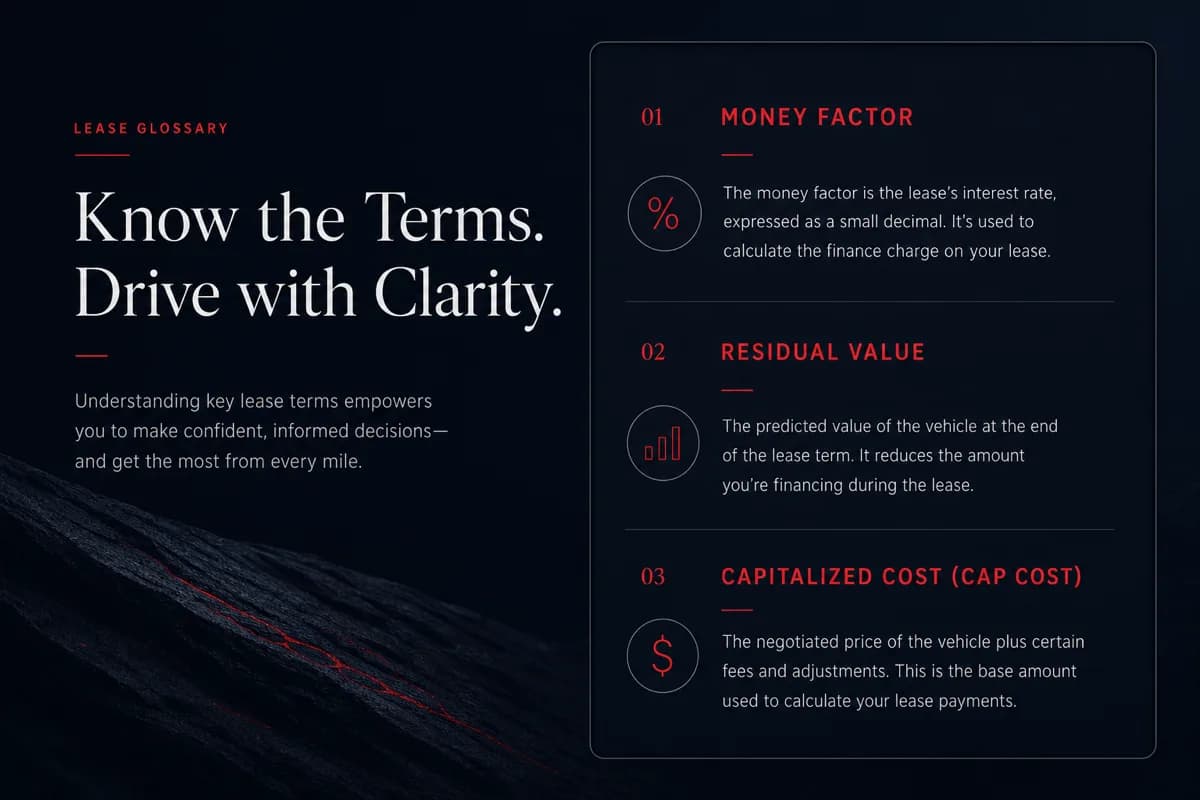
4 minCar lease glossary: key terms explained
Quick definitions of terms you will see in lease ads, quotes, and contracts—written for shoppers, not accountants.
 5 min
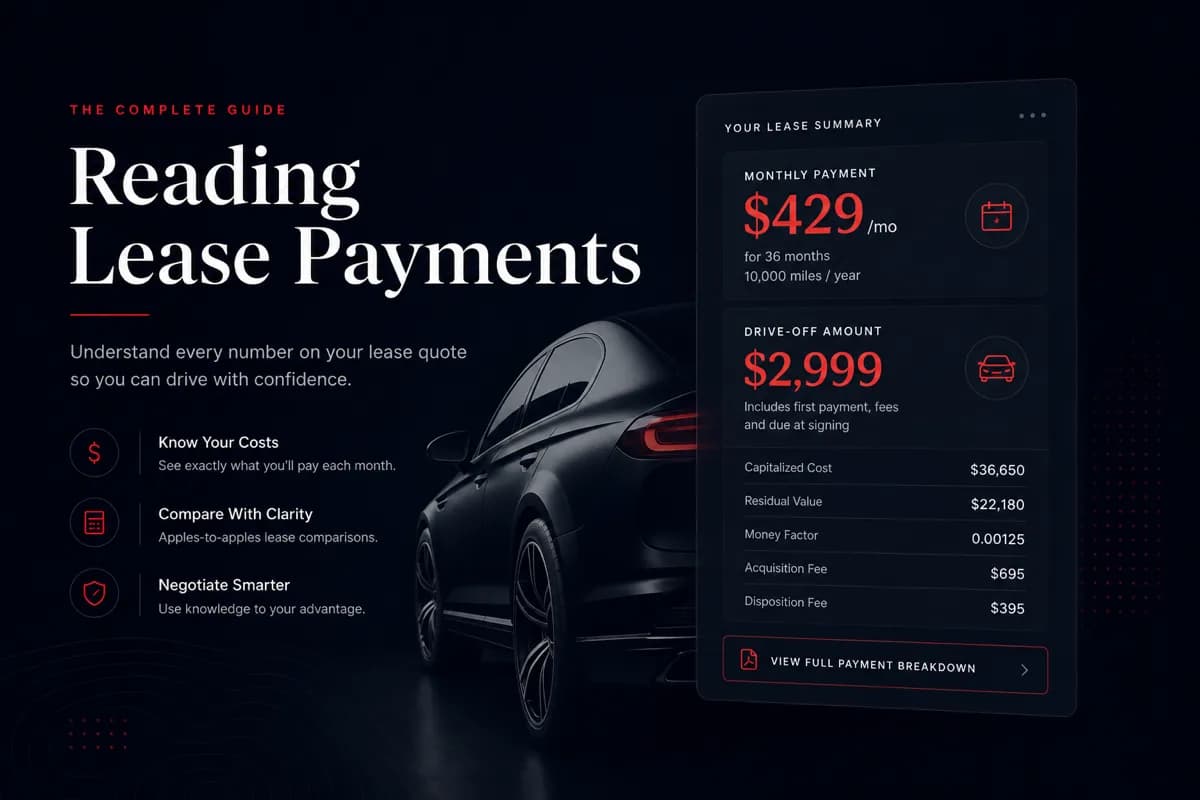
5 minWhat's due at signing on a car lease? Reading payments and drive-off
How to interpret payment, drive-off, term, and mileage when comparing lease listings online or from multiple brokers.
 4 min
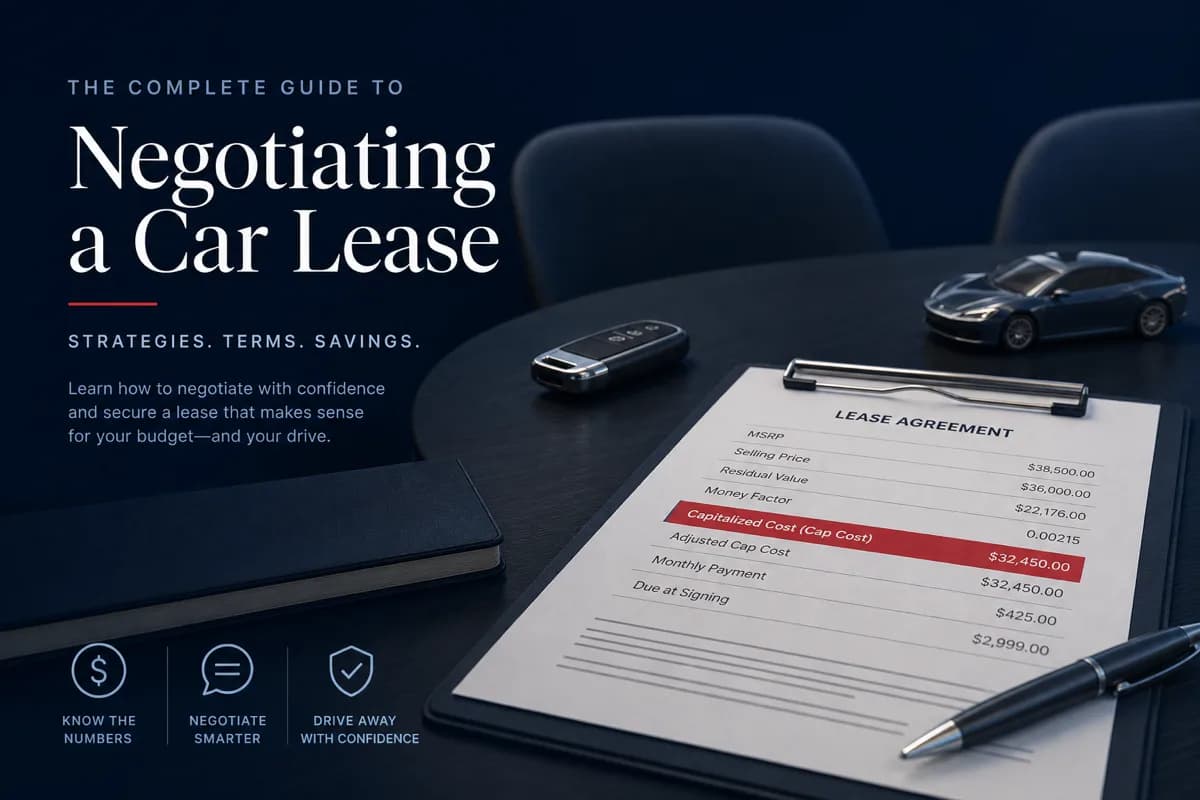
4 minHow to negotiate a car lease
What is negotiable on a lease, what is fixed by the bank, and how to use itemized quotes to improve your deal before you sign.
Ready to compare?
Compare live listings by payment, drive-off, and term, then request help on a deal when you are ready.