
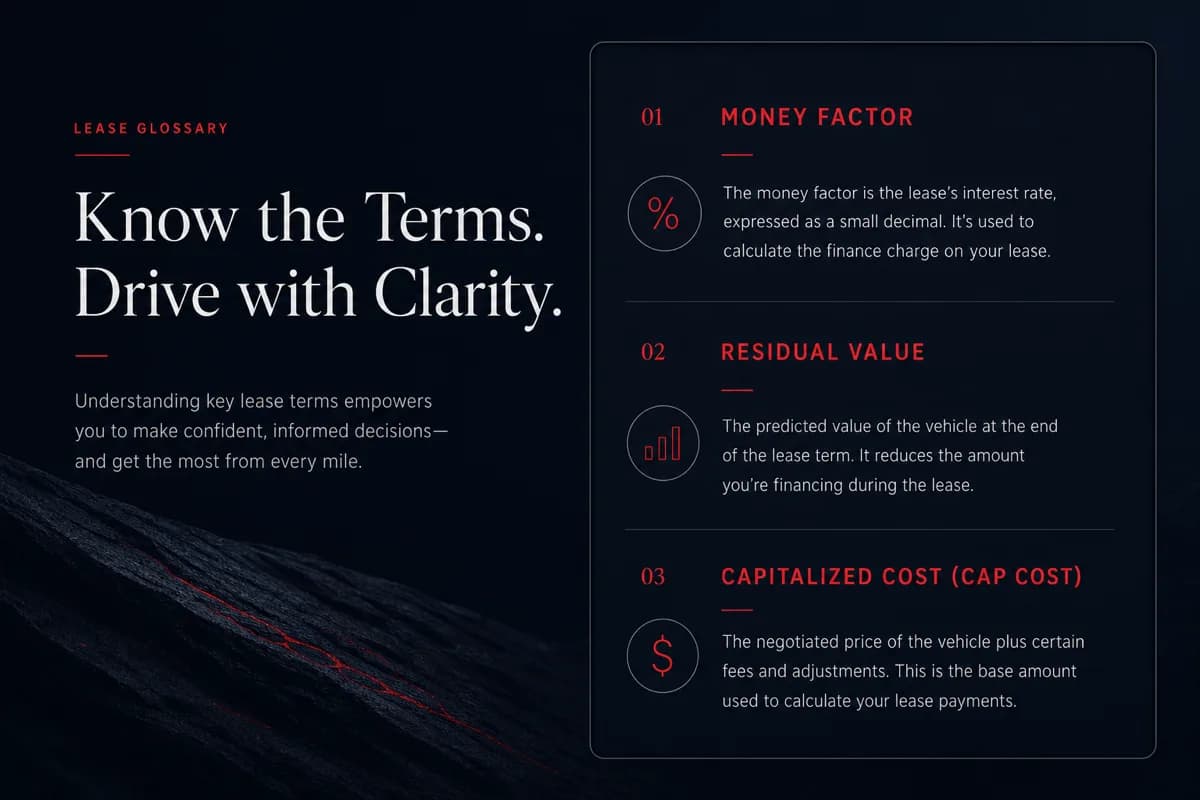
Car lease glossary: key terms explained
Quick definitions of terms you will see in lease ads, quotes, and contracts—written for shoppers, not accountants.
By LeaseGuru.aiUpdated 4 min read
Lease contracts and broker ads use specialized vocabulary—money factor, residual, cap cost—that can obscure what you are actually paying.
You do not need an accounting degree to shop leases. These plain-English definitions map directly to fields you will see on LeaseGuru listings and in quotes.
Bookmark this page when reading ads or reviewing paperwork with a dealer or broker.
TLDR Quick Guide
Quick definitions for the most common lease terms:
- Money factor — finance charge on the lease (like interest on a loan).
- Residual — expected vehicle value at lease end; higher residual often lowers payment.
- Cap cost — amount being leased (price plus fees minus reductions).
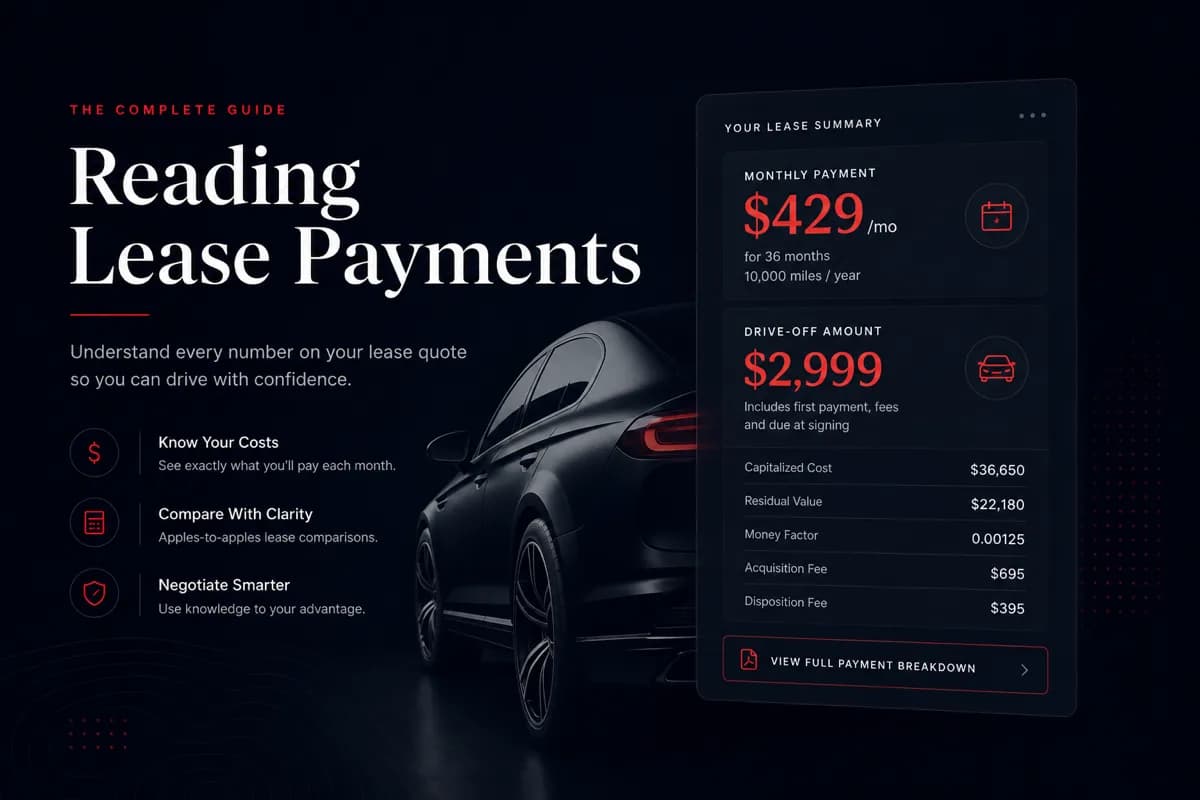
- Drive-off — cash due at signing including first payment, fees, and taxes.
- Acquisition / disposition fees — bank origination fee and optional return fee.
Money factor
The rent charge on a lease is often expressed as a money factor—a small decimal. Some shoppers multiply money factor by roughly 2,400 to approximate an equivalent interest-rate benchmark. Lower money factor generally means lower finance cost within the same deal structure.
Residual value
The residual is the lessor’s expected value of the vehicle at lease end, as a percentage of MSRP or a fixed dollar amount. A higher residual can lower monthly payment, all else equal, because you are financing less depreciation.
Residual is set by the lessor or captive finance company and is not negotiable in the same way as vehicle price on every lease.
Capitalized cost (cap cost)
Cap cost is essentially the amount being leased—similar to a financed amount on a loan. It can include the agreed vehicle price plus fees you roll in, minus cap cost reductions (e.g. rebates or cash down). Negotiating a lower selling price into cap cost improves lease economics.
Acquisition fee
A bank or lessor fee that compensates for originating the lease. It may be paid upfront or rolled into cap cost (increasing payment). Compare this line item when judging competing quotes.
Disposition fee
A fee sometimes charged when you return the vehicle at lease end, covering inspection and remarketing costs. Check your contract for amount and whether waivers or credits apply when leasing again with the same brand.
Cap cost reduction
Cash or rebate applied to reduce cap cost. It lowers monthly payment but is not always the best use of cash—compare total out-of-pocket versus keeping liquidity.
Drive-off / due at signing
Total amount you pay when you sign, which may include first payment, fees, taxes, registration, and any upfront cap reduction. Listings on LeaseGuru show drive-off when the source provides it.
See what is leasing well right now
Live listings ranked by LeaseGuru deal score, with payment, due at signing, and term on each card.
- View deal details
 DemoScore100
2021 Porsche Taycan CPO Turbo S
- Monthly:
- $1,079/mo
- Due at signing:
- $5,499
- Term:
- 24 mo
California
- View deal details
 DemoScore96
2025 Audi A5 Premium
- Monthly:
- $239/mo
- Due at signing:
- $3,999
- Term:
- 24 mo
California
- View deal details
 DemoScore94
2026 Mercedes-Benz GLE SUV 4Matic 350
- Monthly:
- $379/mo
- Due at signing:
- $3,499
- Term:
- 24 mo
South
Key Takeaways
- Money factor and residual are set by the lessor; selling price is your main negotiation lever.
- Cap cost is the leased amount—lower cap cost means lower payment.
- Drive-off and acquisition fees vary by source—always itemize them.
- Disposition fees may apply at return unless waived for loyal customers.
- Use LeaseGuru filters on payment and drive-off once you know these terms.
Ready to see real lease offers?
Share your ZIP and we'll match you with current deals. Free, no obligation.
FAQs
It varies by brand, credit tier, and program. Convert to an approximate APR with our calculator and compare to current loan rates if you are deciding between lease and finance.
Generally no—residuals are set by the captive finance company. You negotiate cap cost and fees instead.
MSRP is the sticker price. Cap cost is what you actually lease after discounts, fees, and reductions—it is the base for your payment calculation.
Sometimes dealers or brokers mark up or waive acquisition fees as part of a deal. Compare total drive-off, not just the fee line in isolation.
Related guides
 5 min
5 minCar leasing 101: how leasing works and what to expect
A plain-English overview of auto leasing: structure, trade-offs versus buying, and what to expect when your term ends.
 5 min
5 minWhat's due at signing on a car lease? Reading payments and drive-off
How to interpret payment, drive-off, term, and mileage when comparing lease listings online or from multiple brokers.
 3 min
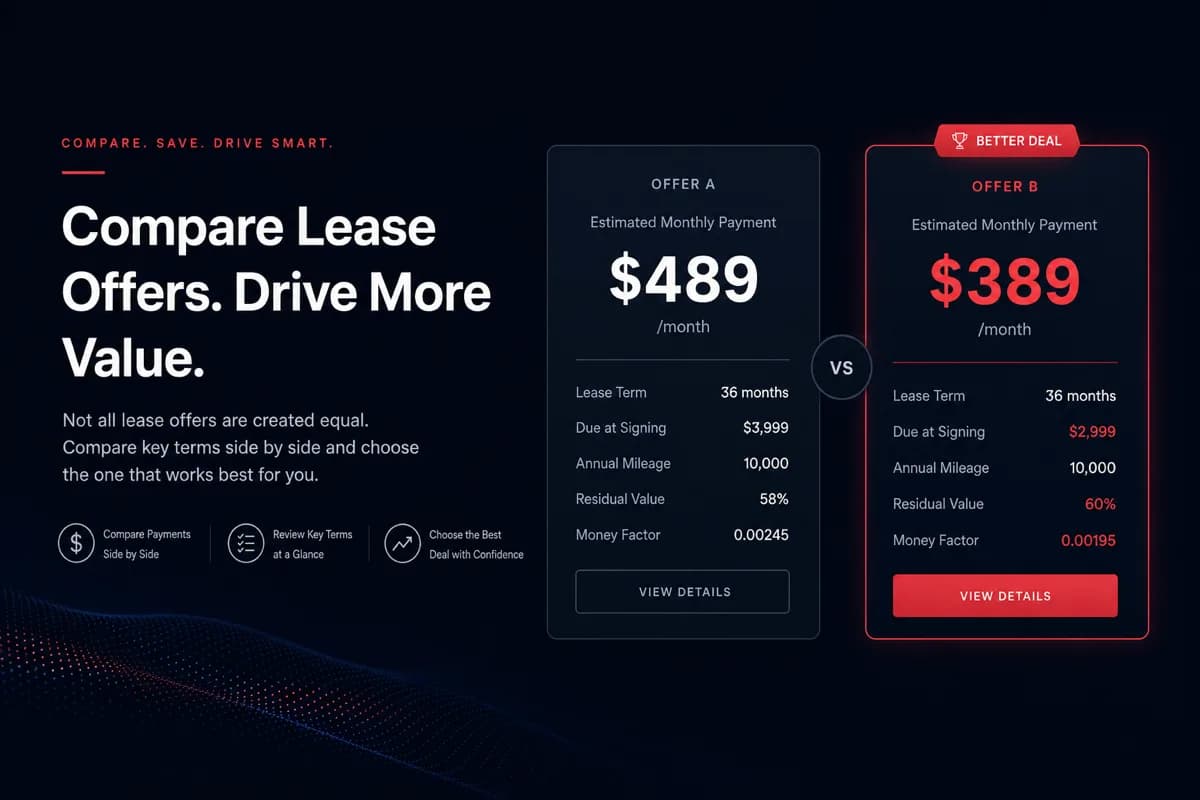
3 minComparing lease offers across brokers and dealers
How to compare specials from different companies side by side when every site formats payment data differently.
Ready to compare?
Compare live listings by payment, drive-off, and term, then request help on a deal when you are ready.